
The Practice of Floating
Start 2026 right as a leader.


There is a particular flavor of exhaustion that defines the end of a year for a CEO, and I remember it well.
It’s more than just fatigue. It’s a psychic weight, an accumulation of the year’s decisions, the ghosts of strategies not taken, the lingering pressure of stakeholder expectations, and the quiet, personal sacrifices made along the way.
You arrive at December’s doorstep feeling like a marathon runner, scanning the horizon for a finish line that seems to perpetually recede.
Now, as a former CEO of Olympia, I can look back on that annual ritual with a different kind of clarity. The distance has not erased the memory of the pressure, but it has revealed the patterns within it.
This year, that clarity feels especially needed. I am writing this to you just a few days after my grandfather passed away, and his loss has cast a stark light on a theme that whispers in the background of every leader’s life: the art of letting go.
It’s a concept we pay lip service to in business—sunk costs, pivoting, killing our darlings—but one we rarely confront in its full, unvarnished truth.
What does it truly mean to let go, not just of a product line or a quarterly target, but of a year, a deeply held belief, or even a person who has shaped the very architecture of our lives?
The End of the Year and the Flow of Time
The Stoic philosophers had a powerful metaphor for this: life as a river. Its current is the relentless, ungovernable flow of time and circumstance.
When you’re a CEO, your instinct is to control this river. You build dams of strategy, divert its course with tactical execution, and measure its flow with KPIs. You believe, on some level, that with enough foresight and force of will, you can command the water. I know I did.
But the river always wins. A market shifts. A competitor emerges from a blind spot. A global event upends everything. Or, in the quiet of a winter morning, a phone call informs you that a chapter of your life has irrevocably closed.
To stand against this current—to cling to the past or resist the inevitable—is not a show of strength. It is a recipe for burnout. It is, as the Stoics would argue, a form of madness, for it is a fight against reality itself.
My grandfather’s passing is a powerful, personal bend in that river. It is an irreversible turn I must now navigate. The old CEO in me wants to fight it, to dwell on the bank of “what was,” to rage against the current that pulled him away.
But the work of a leader, and the work of a human, is to learn to float.
The Stoic’s Choice: What We Can and Cannot Control
This is where the Stoic framework moves from philosophical abstraction to a practical tool for leadership and life.
Epictetus, a man who was born a slave and became a revered teacher, built his entire philosophy on a single, crucial distinction: discerning what is within our control from what is not.
Within our control are our own thoughts, our judgments, our choices, our actions. Outside our control is… everything else. Market dynamics, competitor moves, investor sentiment, illness, and the ultimate timelines of those we love.
The CEO’s mandate is a direct assault on this principle. You are tasked with bending the world to your will. But one of the greatest lessons I learned from my time in that role is the paradox at its heart:
True control is found not in wrestling with the uncontrollable, but in achieving absolute mastery over one’s own response.
Letting go, in this context, is not surrender. It is a strategic reallocation of your most finite resource: your energy. It is the conscious decision to stop wasting it on fighting the river’s flow and to instead pour every ounce of it into steering your raft with integrity and grace.
Applying this to my grief, I cannot change the fact of my loss. But I can choose how I honor my grandfather’s memory.
I can choose to let his legacy inform my actions. I can choose to transform the pain of his absence into a deeper appreciation for the people who are still here. This is not about “getting over it.” It is about integrating the loss into a new reality and choosing a constructive path forward.
The Practice of Floating: How to Actually Let Go
This brings us to the critical question: how? How do you move from understanding this intellectually to practicing it under pressure?
The most profound illustration of this I’ve ever encountered comes from Elizabeth Gilbert, describing a concept known as going “all the way to the river” in her latest book. This isn’t just a phrase; it is a map of friendship and loyalty, drawn against the grid of New York City.
The metaphor works like this: there are the “Fifth Avenue friends,” the ones you see when you are polished and successful. Then, as you move east across the avenues, the friendships deepen. The friends on Avenue A, B, C, and D are the ones who know your struggles, your fears, your unedited self.
But the river—the East River—represents the ultimate edge. It’s the lowest point, the moment of absolute vulnerability, the final shore of life itself. You might only get one person in your life who will go “all the way to the river” with you. This is the person who doesn’t just tolerate your worst moments, but who accompanies you into them, offering unconditional love and support until the very end (which is death in Gilbert’s book).
Letting go, then, is not something we are meant to do alone. It is a journey we take, and if we are lucky, we have someone to walk with us to the river’s edge.
But for the things we must ultimately face by ourselves—the end of a year, the failure of a venture, the finality of a loss—this metaphor offers a different kind of solace.
It gives us a language for our own inner journey. It asks us to be our own “river friend”—to accompany ourselves through our darkest avenues with compassion, to see ourselves through our most vulnerable moments without judgment.
As a CEO, break this practice down into three disciplines:
Acceptance: This is the foundation. It is a clear-eyed assessment of reality, free from the distortion of ego or fear. It is acknowledging which street you are on, right now.
Non-Attachment: This is the ability to cherish a memory, a project, or a person without becoming so fused to it that you cannot move forward. It is loving Fifth Avenue without refusing to walk toward the river.
Gratitude: In the face of loss, the mind gravitates toward the void. The discipline of gratitude actively shifts the focus from what was lost to an appreciation for the journey you had. It is being thankful for the walk, no matter where it ends.
Looking Downstream
The end of the year is a powerful time to practice this. Look back at the year not with judgment, but with acceptance. Acknowledge the blocks you were on. The victories, the failures, the moments of grace, the moments of struggle. See them for what they were.
And then, let them go.
Release the weight of the past year’s regrets. Release the attachment to the plans that didn’t pan out. By letting them go, you don’t erase them. You integrate them as lessons and free up your energy to look downstream.
The river is always moving. The gift of letting go is that it allows us to lift our heads, pick up our paddle, and focus on what’s next.
What’s Next for The First-Time CEO Project?
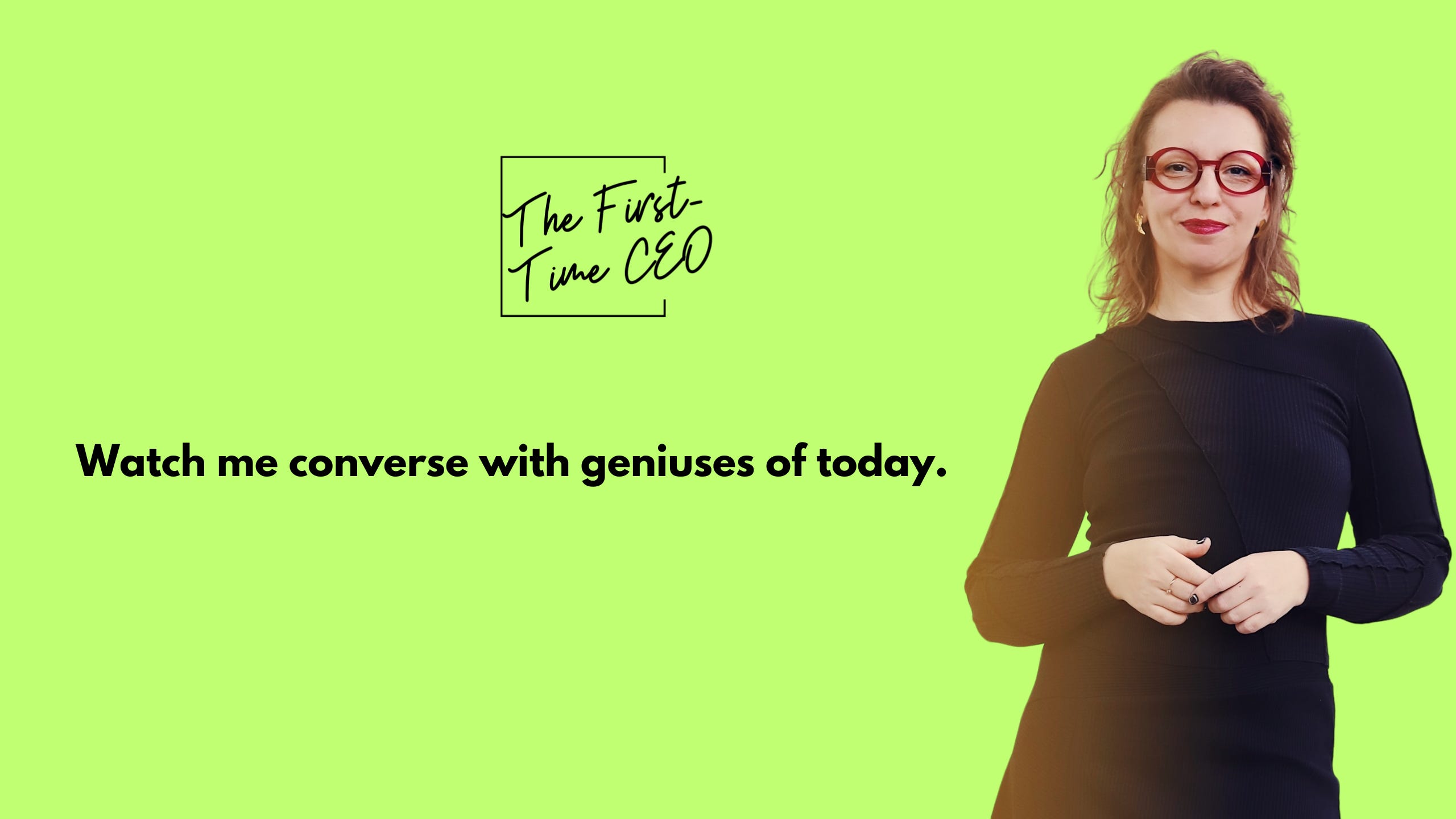
I allowed myself to rest this past December. Visiting my friend on the coast gave me a clear understanding that I want to live by the ocean again, and so I moved.
The fresh air, the stunning views, and the big water were so good for my mental health that I decided to make myself a gift of natural abundance once again (and maybe permanently?).
Giving myself permission to just be, having long walks, breathing salty air, sleeping in, and being lazy was the best decision ever. Getting used to achieving, grinding, and the hustle started making me sick. So I might as well get back to what’s called real life in every moment.
So Season 2 of The First-Time CEO podcast has been postponed, the book I was writing in public, and the newsletter have been paused.
But I feel ready to come back to the project. And this time, not from the place of rush, overachievement, and proving to myself and others that I can no matter what, but from the place of creativity, curiosity, and peace of mind.
First, I will complete Season 1 in the book (and the plan is to do so by March 2026), and then launch Season 2 of the podcast. I’d like to concentrate on one project at a time, instead of mixing all the formats together, potentially burning out before the book is even finished.
I will send you all the updates weekly. And for now I suggest you watch and listen to my amazing guests from Season 1 on:
YouTube, Substack, Spotify, or Apple Podcasts.
And if you’d like to support my work, pre-order my book by tapping on the button below. You can also become a part of the project as a founding member and get some serious perks. In that case, purchase the Founding Membership Pack via the same link, and I’ll contact you shortly for next steps!
#CEOCheck
The question for you to reflect upon this time is:
What can’t you still let go as a CEO?
Happy New Year!
My wish for you, as leaders and as human beings, for 2026, is not a calm river. That is not promised to any of us. I wish you instead the strength to navigate the rapids, the wisdom to accept the current, and the peace that comes from knowing that wherever you are, you are exactly where you need to be.
We’re on this block now. Let’s be here.
Happy New Year!
Let’s Connect!
For more authentic content on leading companies for the first time, follow me on LinkedIn and Instagram, and The First-Time CEO podcast on Spotify, YouTube, and Apple Podcasts. Here you can find more information about me and my career.